


What Botswana's Okavango Delta Can Teach Australia About Protecting Rivers

A field course in one of the world’s great wetlands is training the next generation of water managers. The parallels with the Murray-Darling and Lake Eyre basins are hard to ignore.
A small boat edges through floodwater in the Okavango Delta, carrying students with binoculars, bird guides and cameras. Elephants splash nearby, hippos surface, and vultures wheel overhead. It looks like a safari, but it is a classroom, and the lessons are about Australian rivers as much as African ones.
More than 20 students from Australia, Botswana, the United States and the United Kingdom are taking part in a week-long field course on river basin ecosystem management and the challenges of conserving big river systems. The course is led in part by UNSW’s Professor Richard Kingsford, and the message from its teachers is that the Delta’s troubles are not so different from ours.

A wetland that still behaves like a wetland
The Okavango Delta covers more than two million hectares, a mosaic of islands, woodlands and floodplains where the river empties into the Kalahari Desert rather than the sea. It is UNESCO World Heritage listed. When it was inscribed in 2014, it became the 1000th site on the World Heritage list.
What makes it remarkable is how little it has been tamed. Kingsford notes that, unlike many of the world’s rivers, this one remains largely free-flowing, so its plants and animals still respond to a natural boom-and-bust cycle.
Australians will recognise the rhythm. Our inland rivers and floodplains, from the Channel Country to the Lake Eyre Basin, are shaped by the same pulse of flood and drought. The ecology of the Delta and Lake Eyre (Kati Thanda) is similar in its water, inflows and vegetation.
The water that sustains it starts a long way from the Delta. Most of it falls as rain in the Angolan highlands, filters through tributaries into Namibia, and reaches Botswana, where it floods each winter. The Delta is also biologically rich. It supports more than 440 bird species, a large elephant population, and one of the last strongholds of the endangered African wild dog.
Familiar pressures
The trouble is that the Delta is under strain. Kingsford says rivers around the world face the same pressures: over-extraction, climate change and pollution.
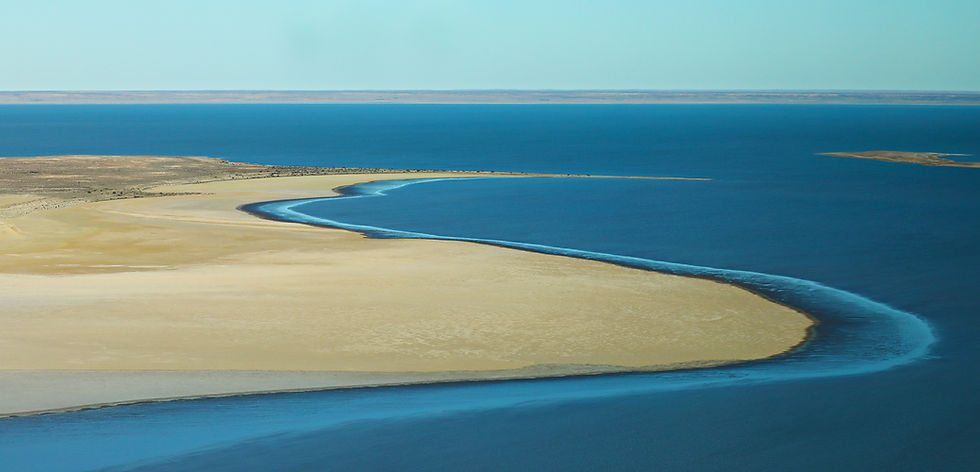
Mpaphi Casper Bonyongo, director of the Okavango Research Institute, sees this first-hand. He identifies upstream development, particularly fast-growing irrigated agriculture, as the biggest threat. He also describes what he sees from the air: flood sizes have shrunk over many years, and the scars of old river channels show where water once reached but no longer does. He links this probably to climate change.
Australians know this story. The Darling River at Wilcannia has suffered several blue-green algae outbreaks in recent years. The Murray-Darling Basin Plan, established with a price tag of about $13 billion, set a target of returning 2,750 gigalitres a year to rivers and wetlands. Researchers who have worked on the Basin’s waterbirds have helped establish that the wetlands of the Murray-Darling Basin are critically endangered.

The Curlew sandpiper is the clearest Lake Eyre Basin example. It is specifically identified as a critically endangered migratory shorebird associated with wetlands such as the Coongie Lakes and other basin floodplains.
Governing water across borders
The most striking parallel is institutional. The Murray-Darling is managed across state lines.

The Okavango is managed across national borders. Botswana, Namibia and Angola share responsibility for the system.
That cooperation has deepened. In 2019, the three countries agreed on a roadmap to explore extending the World Heritage boundary to protect the wider river basin. The logic is simple: a wetland cannot be protected at its downstream end alone. What happens in the headwaters decides what arrives at the floodplain.
Australia has learned the same lesson the hard way. Research on the Menindee Lakes found that river systems function at basin scale but are often governed through mismatched, fragmented structures. The same study argues that decisions need to be adaptive and rest on sound evidence and genuine community participation.
Kingsford says the two river systems share real parallels in how water in big river basins is understood and managed. That is also why the exchange matters. His earlier work developing waterbird-based indicators of wetland health in Australia has already travelled to Africa. A twinning program with the Okavango River Basin now uses a health-measuring method adapted from his research.

Training people, not just collecting data
Part of the course’s value is the data. Students test water, collect data and monitor animal populations to help assess the health of the system, and groups have recorded large swings in flood size and animal numbers over a decade. Long records like these are how scientists tell a bad year from a trend. That is a point Australian agencies could take on board, given how often water decisions are made on thin evidence.
The deeper value may be in the people. UNSW student Sophie Nguyen said seeing how water is managed in Botswana has made her think about how it could be managed back home. Her classmate Isabella Drake said the course gave her insight into large-scale management. Botswanan wildlife researcher Thato Mutumba is already thinking about which Australian and American strategies could be adopted in Botswana.
Professor Dave White of Arizona State University argues that universities should be a force for social good, and that combining the strengths of different institutions can drive impact at scale. The course has run since 2017, and organisers say former participants now work in conservation around the world.

Research: “Engaging Farmers and Climatologists in Adaptation to Climate Variability and Change in the Okavango Delta of Botswana”
What Australia can take from it
Reading across the reporting, several lessons stand out. These are my readings, not conclusions drawn by the researchers.
Protect flow before it’s lost. The Okavango is valuable partly because it still floods naturally. Where rivers are already heavily regulated, as many of ours are, restoring some of that natural variability is far harder than preserving it.
Manage the whole catchment. The Delta’s biggest threats arise upstream, not in the wetland itself. Australian water policy has the same tension between headwater and floodplain interests.
Invest in long-term monitoring. Decades of waterbird surveys have shaped Australian policy, and similar data is now tracking change in Botswana.
Share knowledge both ways. Botswana has things to learn from Australia, and the reverse is also true. Cross-border river governance is difficult everywhere, and no country has solved it.
Train people to think at basin scale. The managers who will make decisions about the Murray-Darling and Lake Eyre in 2050 are students today.
A shared future
Nguyen summed up the course’s premise in a single idea: good management strategies need not be tied to one place. It is a modest claim with large implications. The Okavango and the Murray-Darling sit on opposite sides of the Indian Ocean, yet they face the same pressures. If students who meet in a boat on a Botswana floodplain take their ideas home, both rivers may be better off.
💦
REFERENCE
ABC News (Bill Ormonde, 9 October 2026);
UNESCO World Heritage Centre;
UNSW; Ecology and Society (Ford et al., 2023).


Comments